
Downtown Cary Multi-Modal Center FAQ
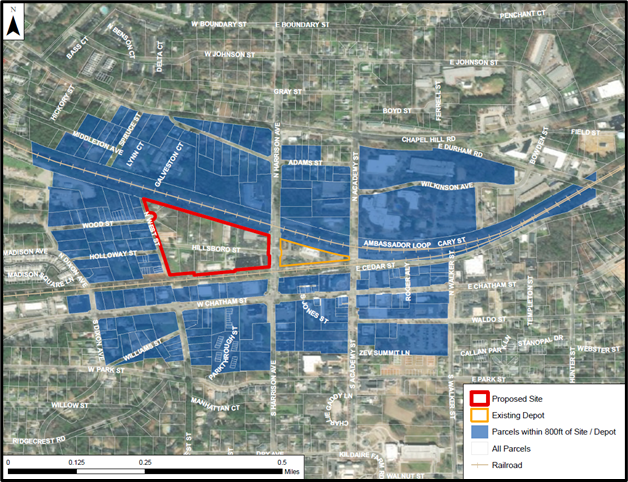
A Multi-Modal Center is a place where multiple modes of transportation come together. It is a place where it is easy to make connections between modes of getting around, such as walking or riding a bicycle to catch a bus or taking a rideshare vehicle to catch a train. It can also be a destination for reasons other than transit, such as meeting friends for dinner, shopping for a birthday gift, or attending a community meeting.
The Wake Transit Plan details a program of transit improvements which include expansion of local and regional bus service, new Bus Rapid Transit (BRT), and opportunities for future Commuter Rail service. The current location for transit service, the Cary Depot, does not have the capacity to support these new transit services which will connect Cary citizens to the region.
As the feasibility study evaluated potential locations for a new Multi-Modal Center, several considerations were critical. Amtrak intercity rail service requires access to both rail lines running through downtown, and the facility requires a section of straight track that is at least 800 feet long to accommodate a longer passenger platform. The site must also accommodate future Bus Rapid Transit and Commuter Rail services. The location should also provide opportunities for mixed-use development, in line with Cary’s vision for a vibrant downtown.
Cary worked with WSP to conduct a Downtown Cary Multi-Modal Center Feasibility Study. Site selection was a major task of this study. WSP provided a “Cary Multi-Modal Site Selection Analysis Report” which details the locations that were considered and the rationale for the final recommendation.
The Multi-Modal Center will serve many purposes, some of which are known at this point, and some of which are still to be determined. The Multi-Modal Center will serve as a transportation hub for local and regional bus service, Bus Rapid Transit (BRT), intercity passenger rail, and future commuter rail. It will also offer opportunities for bike- and ride-share connections.
The Cary Community Plan envisions a downtown that is supported by a multi-modal transportation center. This center is a catalyst for supportive mixed-use development that could include retail, commercial, and residential space, community gathering areas, and places for public meetings. As this project moves forward, there will be additional opportunities for the public to share what they would like to see included in this project.
In addition to better regional public transportation access and development opportunities, this project will improve the wait time at the train crossings on Harrison Avenue and Academy Street. The length of track at the existing Depot is approximately 560 feet, with a platform of roughly 400 feet. This means when a train pulls into the station it cannot clear the intersections, so the gates remain down while passengers board and disembark. The train may also need to pull forward and stop a second time to access the baggage car. A platform length requirement of 800 to 1,000 feet at the Multi-Modal Center means that trains will have more room to serve the new station without regularly blocking the intersections with stopped trains.
The Town needed to acquire property within the proposed project area in order to construct the Multi-Modal Center. Each situation was unique and the Town worked directly with all individuals affected to minimize disruptions. Additionally, the project is in accordance with all applicable laws and regulations, including the Uniform Act of 1970, which affords many rights and protections to property owners and leaseholders. This may include assistance with finding replacement housing and financial assistance for relocation.
The role of the existing Cary Depot will be considered during the design phase of this project, which is anticipated to begin in 2026. Once the design phase begins, there will be additional opportunities for the public to provide feedback on the project.
The Town of Cary/GoCary and regional transit partners continue to increase and expand local and regional bus service according to the Wake Transit Plan. The Wake Transit Plan was approved by voters in 2016 and is funded by a ½ cent sales tax. In addition to the Wake Transit Plan, the Town of Cary receives an annual apportionment from the Federal Transit Administration for operations. View Cary’s FY21 Budget Document (page 230) for more information.
Abatement is the process of safely removing, encapsulating, or isolating hazardous materials (e.g., asbestos, lead). Demolition is the structural destruction of a building. Abatement must occur before demolition.
The work area is isolated (contained), workers are protected with specialized gear (Tyvek suits, respirators), water may be sprayed inside the building to minimize fiber release within the structure, and air monitoring occurs throughout the process.
Only trained and certified professionals are permitted to perform asbestos abatement to ensure safety.
Hazardous materials are legally required to be removed and transported to specialized landfills.
Contractors use engineering controls, such as HEPA filters for air ventilation and water sprays to minimize dust and fibers.
Demolition is the structural destruction of a building in a controlled environment. This is usually done for safety, to make space for new buildings, or to replace old and unsafe structures. It typically involves site inspection, obtaining permits, disconnecting utilities, structural demolition, debris hauling, and site cleanup.
Medium-sized equipment such as excavators, dump trucks, and water trucks may be used during demolition work.
Demolition projects involve sorting, recycling, and responsible disposal or reuse of materials in accordance with environmental regulations.
Kelly Blazey, Transit Director
919-462-2080
kelly.blazey@carync.gov